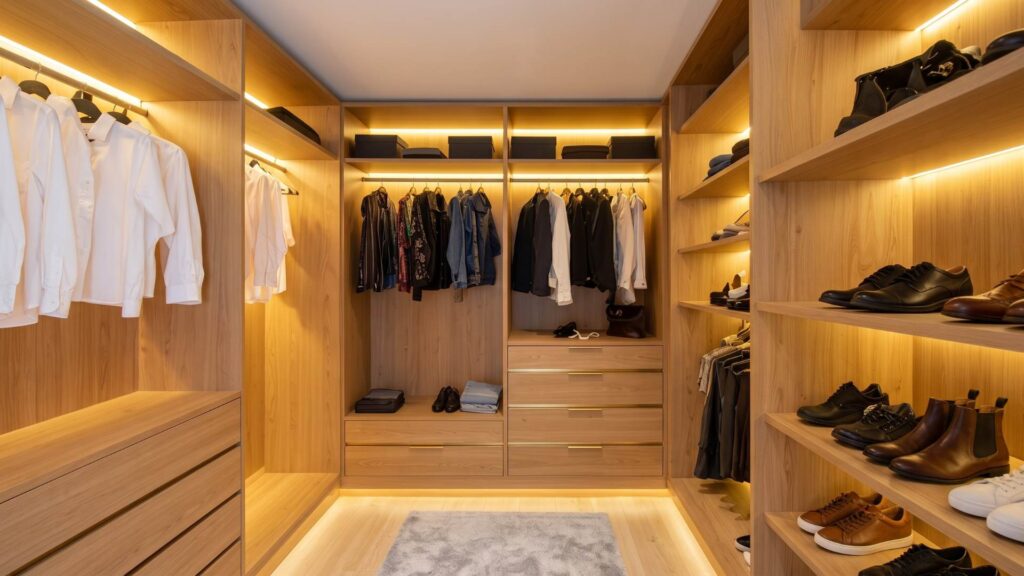

A gorgeous custom closet completely falls flat if the lighting inside is terrible. You can spend a fortune on premium shelving, glass-front drawers, and a perfectly organized layout. But if you can’t tell navy blue from black under the lights you bought, none of that matters when you are rushing to get dressed at 6 AM. Good custom walk-in closet lighting does more than just brighten up a dark room.
It changes how accurately you see your clothes, how functional the space is day to day, and how much you actually enjoy using it. We are going to look at exactly how to map out your walk-in closet lighting. This means layering your fixtures the right way and picking a color temperature that won’t leave you second-guessing your outfit choices every single morning.
Table of Contents
1. Start with Layered Lighting
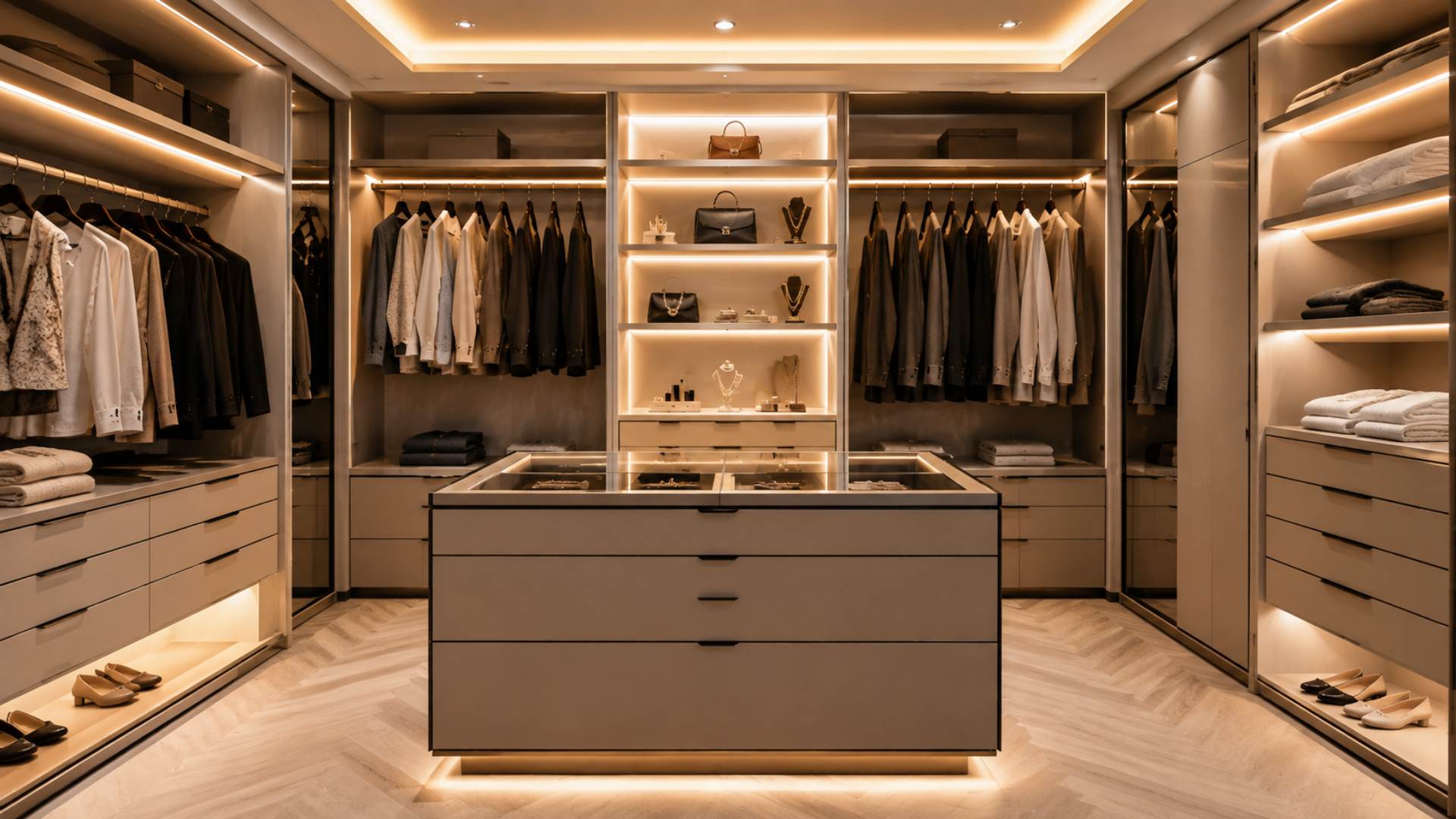
The single biggest mistake people make with lighting for custom walk-in closet spaces is relying on one overhead fixture and calling it done. A single ceiling light creates shadows in corners, along shelving, and inside drawers, exactly the spots where you actually need to see clearly.
Layering solves this by combining ambient light for general illumination, task lighting for specific activities like reading labels or matching colors, and accent lighting to highlight display shelves or a jewelry case. Think of it the same way you’d approach kitchen lighting, one source overhead, another under the cabinets, and maybe a third over the island.
A closet deserves that same layered thinking, just scaled to its size. Once you commit to this approach, everything else, fixture placement, LED strips, color temperature, becomes far easier to plan out properly.
2. Choose the Right Ceiling Fixture
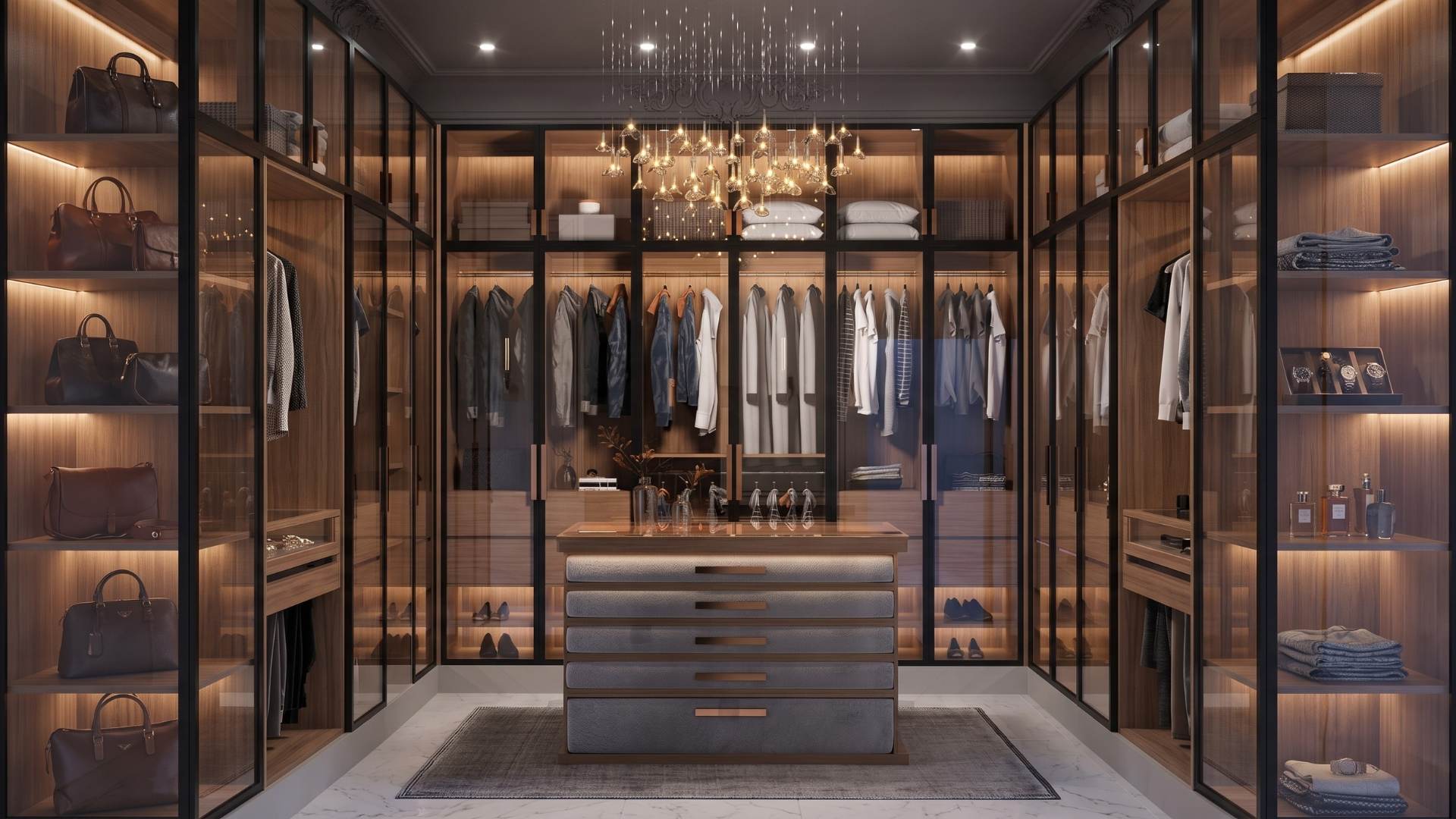
Your primary ceiling fixture sets the baseline for the entire room, so getting it right does matter. Recessed lights are the most common choice for custom walk-in closet lighting, and for good reason. They sit flush with the ceiling, so they don’t interfere with high shelving or hanging rods, and they distribute light evenly across the whole floor plan without creating a single hot spot in the center of the room.
For larger walk-ins, spacing two or three recessed fixtures throughout the space works far better than one central light trying to cover everything alone. Flush mount fixtures work well too, particularly in smaller closets or wardrobes where recessed lighting isn’t practical due to ceiling depth.
Whatever you choose, avoid anything with a shade or diffuser that dims output significantly, since closets already tend to be enclosed spaces without much natural light bouncing around to compensate.
3. Add LED Strip Lighting Where It Matters Most
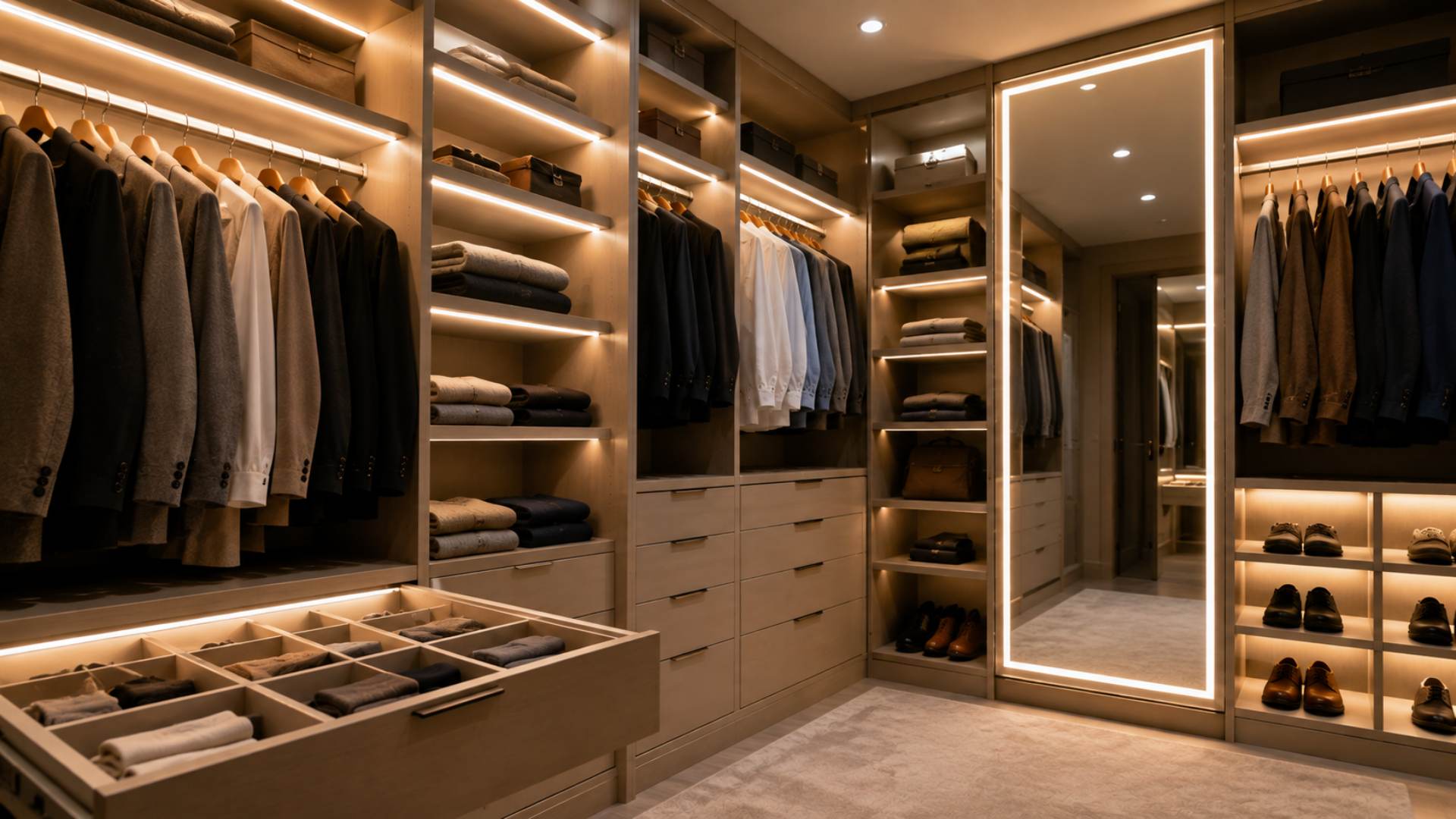
This is where your closet actually becomes useful. Putting LED strips under your shelves, inside drawers, or around your hanging clothes completely gets rid of the shadows that a regular ceiling light misses.
If you have ever dug through a pitch-black drawer looking for a specific pair of socks, you already know why this is a game changer. Sticking these strips on the edges of your shelves lights up the clothes below them directly. That is super helpful for folded stacks when you need to see the exact color and fabric instantly.
Strip lighting around a full-length mirror also adds a soft, even glow. It is way better for checking your outfit than a single, harsh overhead bulb. Plus, a lot of the newer strip options have motion sensors built right in. They turn on automatically the second you open a drawer or step inside, so you never have to fumble around for a light switch in the dark.
4. Pick the Right Color Temperature
Color temperature is measured in Kelvin, and it determines whether your light reads warm and yellow toned or cool and blue toned. This single decision affects the entire feel of your closet more than almost any other lighting choice you’ll make.
3000K vs 3500K vs 4000K
3000K produces a warm, cozy glow similar to traditional incandescent bulbs. It’s flattering and comfortable, but it can slightly warp how true colors, particularly blues and blacks, actually appear.
3500K sits in the middle ground, still warm enough to feel inviting but with enough neutrality that color accuracy improves noticeably compared to 3000K. This is a genuinely solid default for most walk-in closet lighting projects.
4000K delivers a crisp, neutral white light that closely mimics daylight conditions. Colors render accurately here, which matters enormously if you’re someone who needs to distinguish between similar shades of navy, black, or charcoal without walking to a window first.
Which Color Temperature Is Best for Clothing?
For pure color accuracy, 4000K is the strongest choice. Professional retail stores overwhelmingly favor neutral, cooler lighting between 3500K and 4000K. They do this because it displays fabric colors much more accurately than warm lighting. However, a home closet is a personal space rather than a commercial showroom.
If you find 4000K too clinical for comfort, 3500K offers a reasonable middle ground. It balances warmth with color accuracy. The right answer depends entirely on your daily routine. You have to decide whether color matching or ambiance matters most to you.
5. Don’t Ignore CRI (Color Rendering Index)
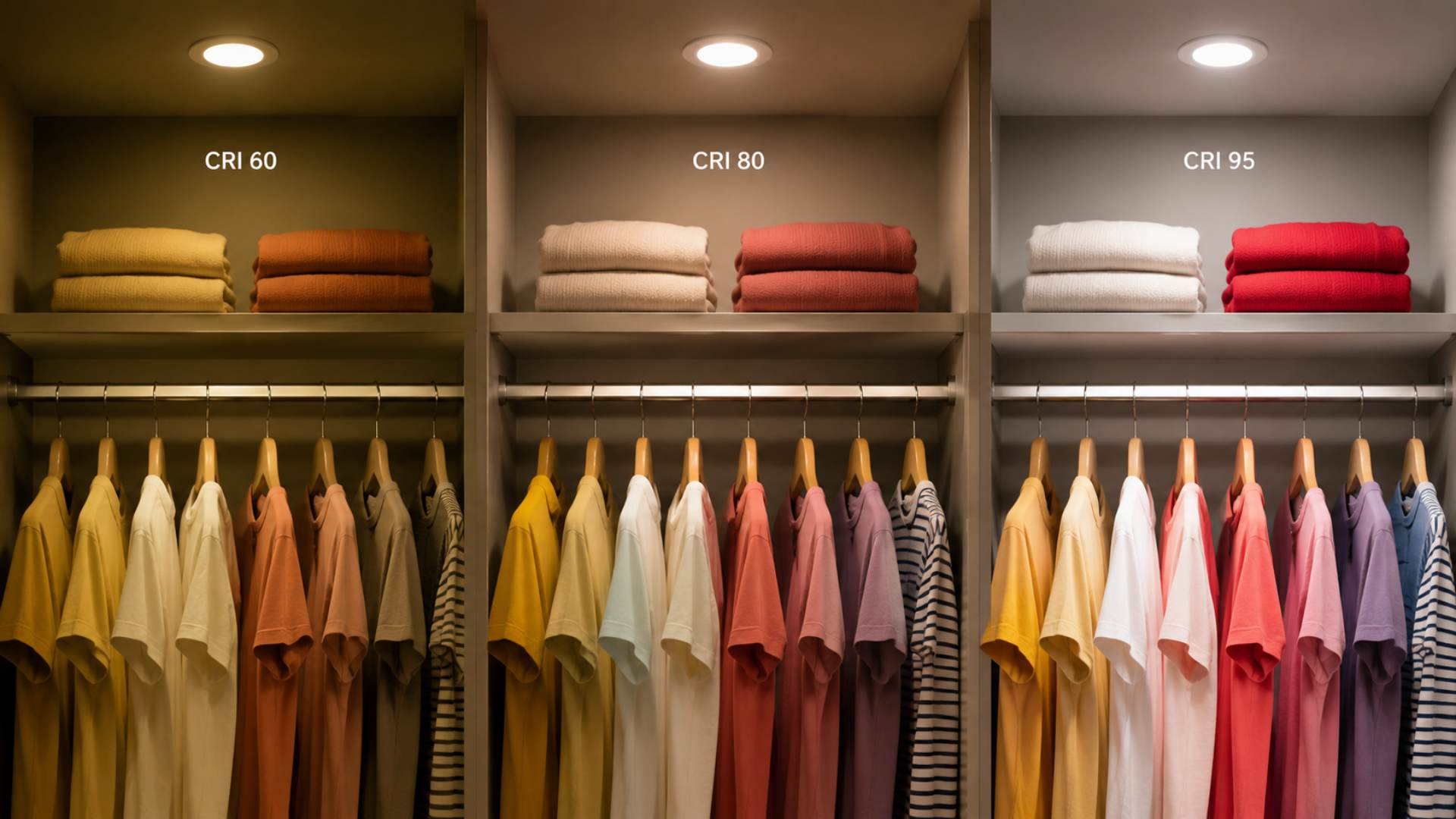
CRI measures how accurately a light source renders color compared to natural daylight, scored on a scale from 0 to 100. This number gets overlooked constantly in favor of wattage or color temperature, tho it might matter more than either one for a closet specifically. Two bulbs can share the exact same color temperature and still render colors completely differently depending on their CRI rating.
Why You Should Choose CRI 90+
A low CRI bulb can make a burgundy sweater look flat brown, or leave two different blacks looking identical when they’re actually noticeably different shades in daylight. Industry standards for retail environments where accurate color perception directly affects buying decisions consistently call for a CRI of 90 or above, and that same standard applies just as directly to your own closet.
If you’re relying on your closet lighting to help you actually put together a coordinated outfit, anything below CRI 90 is genuinely working against you. Most quality LED fixtures now list CRI on the packaging, so it’s worth checking before you buy rather than assuming all LEDs perform the same.
Frequently Asked Questions (FAQs)
Should closet lights be warm or cool?
For color accuracy, cooler light in the 3500K to 4000K range performs better, since it renders true color without the yellow cast warmer bulbs introduce. If ambiance matters more to you than precise color matching, a warmer 3000K option still works fine for general use.
What is the best color temperature for a closet?
Most lighting professionals recommend somewhere between 3500K and 4000K for closets, balancing accurate color rendering with a temperature that still feels comfortable rather than overly clinical or sterile.
How bright should a walk-in closet be?
Closets generally benefit from higher lumen output than bedrooms since you’re performing detailed tasks like color matching and reading labels. Layering ambient, task, and accent lighting together typically delivers better usable brightness than relying on a single bright fixture alone.
Wrapping Up…
Getting custom walk-in closet lighting right comes down to layering your fixtures properly, choosing a color temperature that suits how you actually use the space, and paying real attention to CRI rather than treating it as an afterthought. Recessed ceiling fixtures paired with LED strips under shelving and around mirrors solve the shadow problem that plagues so many closets. Combine that with a CRI 90+ bulb in the 3500K to 4000K range, and you’ve got a space that actually helps you get dressed correctly every morning, not just one that looks nice in photos.