

Medicine pays well, though it also demands everything. Long hours, high liability, administrative burden, and the kind of mental load that does not switch off at 5 p.m. According to a survey from Sermo, 54 percent of physicians already have a side hustle, and households earning above $100,000 per year are more likely to pursue additional income streams than lower-income households, according to Bankrate.
The pattern is clear. High earners who understand money recognize that relying on a single income source, even a substantial one, is a fragile financial position. Passive income for doctors is not about necessity so much as it is about building the kind of financial security that gives you real options over time. Here are seven approaches worth considering.
Table of Contents
7 Passive Income Ideas for Doctors
1. Invest in Real Estate

Real estate is the most consistently discussed physician side income vehicle for good reason. Rental income from residential or commercial properties produces monthly cash flow that does not require your active time once the investment is properly structured. A single-family rental, a small multifamily property, or a commercial space near a medical district all produce recurring revenue alongside long-term appreciation.
The physician advantage in real estate is access to capital. A doctor with a strong income and solid credit can finance properties at favorable terms that most investors cannot access. Real estate syndications and partnerships are another route for those who want real estate exposure without the landlord responsibilities. These pooled investments allow you to participate in larger commercial projects as a limited partner, contributing capital while a managing partner handles operations.
The tax treatment of real estate investment also deserves mention. Depreciation deductions, 1031 exchanges for deferring capital gains, and mortgage interest deductions all work in favor of high-income earners who need to manage their tax exposure. This is one of the strongest passive income for doctors channels available when the investment is structured thoughtfully from the start.
2. Build a Dividend Stock Portfolio

A dividend stock investment portfolio is one of the most straightforward passive income ideas for doctors at any stage of their career. Dividend-paying stocks in sectors like healthcare, utilities, consumer staples, and financial services produce quarterly income that compounds when reinvested over time. A $500,000 portfolio positioned in quality dividend stocks yielding four to five percent annually produces $20,000 to $25,000 per year in passive dividend income without selling a single share.
The long term wealth compounding effect is what makes this approach particularly powerful for physicians who start early. A doctor in their 30s who builds a consistent investment discipline across the following two decades ends up with a portfolio that generates meaningful income entirely independently of their clinical work. Index funds with dividend focus, individual blue-chip dividend payers, and REITs that distribute at least 90 percent of taxable income are all valid building blocks for this kind of investment portfolio.
3. Create and Sell Online Courses

Medical expertise translates directly into online courses that both patients and other healthcare professionals will pay for. A physician who understands a specific condition, treatment protocol, lifestyle intervention, or procedural skill has knowledge that an enormous audience cannot access in any other format. Online courses built on platforms like Teachable, Kajabi, or Udemy produce recurring revenue from a single production investment that can sell for years without additional work.
The demand for doctor-created health education content has never been higher. Patients are increasingly active in managing their own health, and they are willing to pay for credible, medically accurate courses on chronic disease management, nutrition, mental wellness, surgical preparation, or specialty knowledge. A well-structured course from a credentialed physician commands a premium price that generic health content cannot. This sits at the top of most passive income ideas for doctors lists specifically because it requires no capital, only time upfront and a willingness to share what you already know.
4. Publish Digital Products

Beyond full courses, digital products represent a lower-effort entry point into passive income opportunities for physicians who want to start smaller. Medical reference guides, patient education PDFs, symptom checkers, dietary protocols written for specific conditions, or practical health guides for specific demographics all sell as digital downloads through platforms like Etsy, Gumroad, or a personal website.
The production investment for a well-researched PDF guide is a weekend of work. Once listed, it generates sales without any further active involvement. Doctors who build a catalog of 20 to 30 quality digital products across a related health niche create a meaningful passive income stream that scales with traffic rather than requiring additional time per sale.
5. Invest in Healthcare or Private Businesses

Doctor investment ideas that leverage medical expertise directly include investing in healthcare-adjacent businesses where your professional knowledge gives you an informational edge. Medical device companies, health technology startups, specialty pharmacy operations, outpatient surgical centers, urgent care franchises, and medical real estate all fall into this category.
Private equity investments and angel funding rounds in healthcare companies allow physicians to participate in the financial upside of the industry they understand better than most investors. The risk profile here is higher than dividend stocks or rental real estate, but so is the potential return. Physicians who have built financial reserves and want to allocate a portion toward higher-growth investments consistently look at healthcare private business investment as the most natural fit for their expertise and network.
6. License Intellectual Property or Medical Content
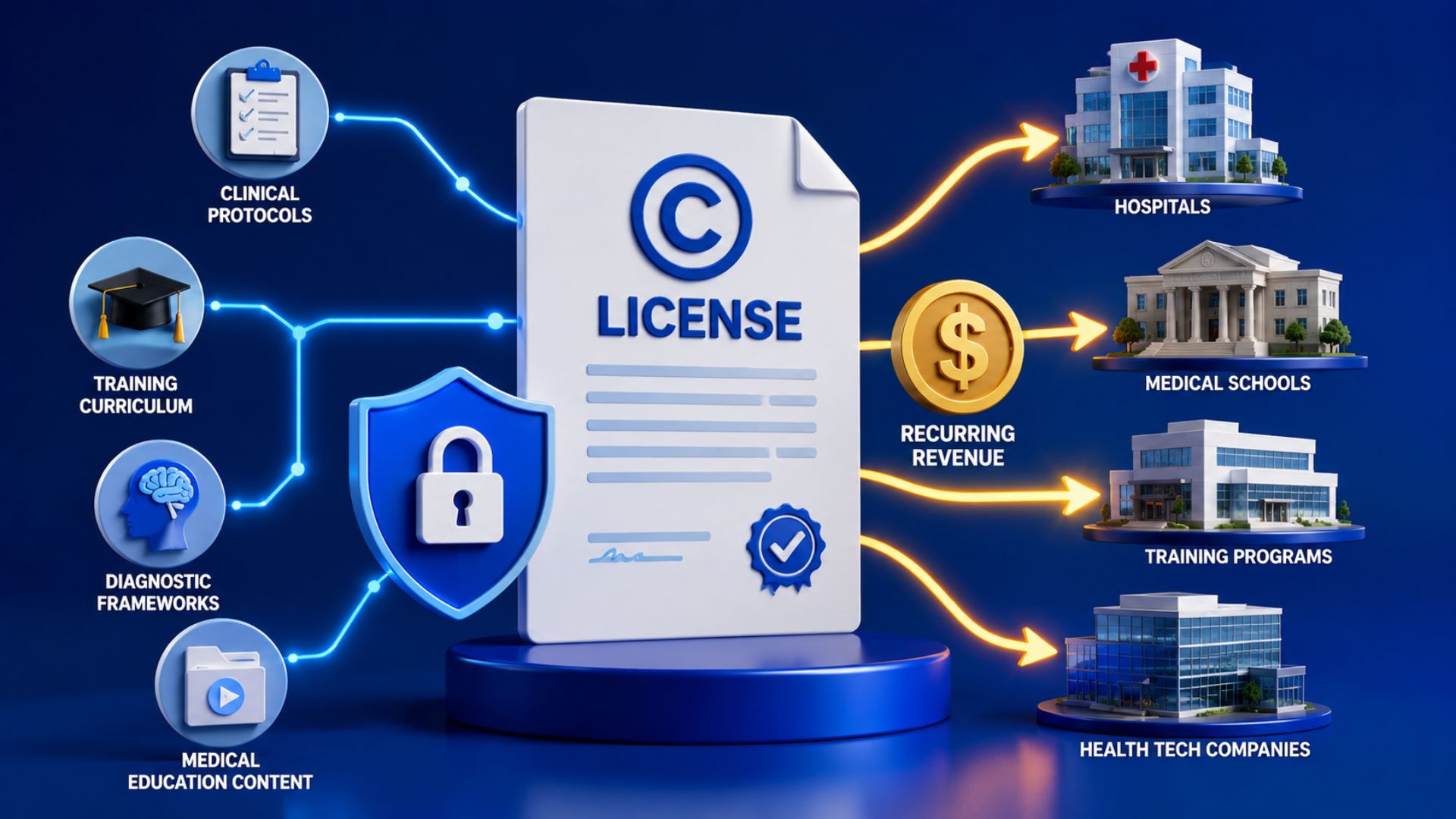
Income streams for doctors who have developed proprietary tools, assessment frameworks, treatment protocols, training materials, or medical education content include licensing that intellectual property to hospitals, medical schools, training programs, or health technology companies. Licensing produces recurring revenue without transferring ownership, meaning the same asset generates income across multiple licensees simultaneously.
A physician who has developed a clinically validated patient education program, a specialized training curriculum for residents, or a diagnostic framework that other practitioners want to use can license that content for an annual fee per organization. The more specialized and credibly validated the content, the stronger the licensing position. This is one of the more underutilized passive income for doctors approaches because most physicians do not recognize the commercial value of the systems and tools they have already built through years of practice.
7. Build a Content Website or YouTube Channel

A content website or YouTube channel built around medical expertise produces advertising revenue, affiliate commissions, and sponsored content income that grows with audience size and compound over time. A physician-authored website on a specific health condition, specialty area, or patient population builds search authority that generates ongoing organic traffic without paid promotion.
The monetization layers on a content website include display advertising through networks like Mediavine or AdThrive, affiliate partnerships with health products and services, and eventually digital products or courses sold directly to the audience the content has built. A YouTube channel with 50,000 to 100,000 subscribers in a medical niche generates meaningful recurring revenue through YouTube’s Partner Program alone, before any brand partnerships or product sales are factored in.
Physician-created content carries inherent credibility that positions it above generic health content in both search rankings and audience trust. The long-term wealth building potential of a content asset that compounds in authority and traffic over years makes this one of the more durable passive income ideas for doctors with a willingness to invest time in the early stages.
Which Passive Income Idea Is Best for You?
The right answer depends entirely on where you are in your career, how much capital you have available, and how much time you can allocate in the near term. Real estate and dividend stocks require capital but minimal ongoing time. Online courses, digital products, and content websites require time upfront and compound over years with minimal additional investment. Healthcare business investing requires both capital and a network. Licensing requires existing intellectual property worth commercializing.
Most physicians who build meaningful passive income for doctors portfolios do not choose one approach. They start with the one that fits their current constraints, build it to a functional level, and then layer in a second stream once the first requires less active attention. The compounding effect of two or three well-structured passive income streams over a decade produces financial freedom for doctors that clinical income alone rarely creates, regardless of specialty or compensation level.
Wrapping Up…
The physicians who achieve real financial security are almost never the ones earning the most from clinical practice. They are the ones who built income streams that continued generating cash flow whether they were seeing patients or not. Fifty-four percent of surveyed physicians already have a side hustle, and the data on wealth building consistently shows that income diversification protects against the income disruption that health issues, burnout, regulatory changes, or practice transitions can create at any point in a career. Passive income for doctors is not a side project. For most physicians who pursue it deliberately, it becomes the foundation of the financial life they actually wanted when they chose medicine in the first place.